
|
SECTION A – The following are the official rules of the Herrin Bocce Club. They shall be in force for all tournaments and leagues sanctioned by the Herrin Bocce Club. Any tournament director wishing to use modified rules should request a waiver from the Herrin Bocce Club Rules Committee.
SECTION B THE COURT AND EQUIPMENT
1.Court
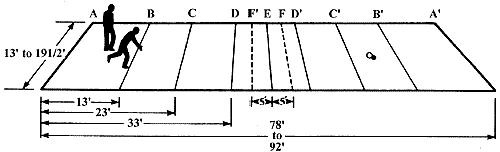
a. The Court is an area 12 feet wide by 70 feet long. (See Court Diagram.)
b. Court Surface may be composed of stone-dust, dirt, clay, grass or artificial surface provided there are no permanent or temporary obstructions in the court that would interfere with the straight line delivery of a ball from any direction. These obstructions do not include variations in grade or consistency or terrain.
c. Court Walls are the side and end walls of the court and may be composed of any rigid material. The walls must be at least as high as the bocce balls at all points. The side or end walls may be utilized during play for bank shots or rebound shots.
d. Markings (See Court Diagram.) All courts should be clearly marked for the following:
1)0.1 foot from side boards in-bounds for first toss of pallina
2)2) 1 foot from back boards in-bounds for first toss of pallina
3)3) 6 feet from back boards foul line for pointing
4)4) 10 feet from back boards foul line for hitting or spocking
5)5) Half court marker minimum distance pallina may be played on first toss of pallina. During the course of play, the position of the pallina may change as a result of normal play; however, the pallina may never come to rest closer than the half point marker or frame is considered dead.
2.Equipment
a.Bocce Balls may be composed of wood or metal and of equal size. Official league and tournament ball sizes may be from 107mm (4.25") to 113mm (4.5"). The color of the balls is immaterial provided that the four balls of one team are clearly and visibly distinct from the four balls of the opposing team.
b.Pallina must not be larger than 63mm (2.5") or smaller that 48mm (1.875") and should be of a color visibly distinct from both bocce ball colors.
c. Measuring device may be any device that has the capacity of accurately measuring the distance between two objects, and acceptable to tournament officials.
SECTION C RULES OF COMPETITION
1.The Game
a. Equipment Bocce is played with eight large balls and one smaller target or object ball called the pallina (jack, cue, beebee). There are four balls to a side or team, and they are generally made in two colors to distinguish the balls of one team from those of the opposing team. The large balls are also inscribed with distinctive lines to identify the balls of the players on the same team.
b.Pallina and Color A coin toss by the referee will determine which team has the pallina and choice of ball color. In the absence of a referee, the two team captains will execute the coin toss.
c.Sequence of Play The pallina is rolled or tossed by a member of the team having won the coin toss to start the game. The pallina cannot hit the back wall on the initial toss and must come to rest in the area defined above. The player tossing the pallina must deliver the first ball. The opposing team will then deliver their bocce balls until the point is taken or they have exhausted their four balls. This "nearest ball" rule governs the sequence of played balls. The side whose ball is the closest to the pallina is called the "in" ball and the opposing side the "out" ball. Whenever a team gets "in", it steps aside and allows the "out" team to deliver.
d.Three Attempt Rule The team possessing the pallina will have three attempts at placing the pallina within the acceptable playing area described above. If these three attempts are unsuccessful, the opposing team will have one opportunity to place the pallina. If this attempt is unsuccessful, the referee will place the pallina in the center of the court width at the 15.24m. (50') mark (opposite end hitting line). However, at no time does a team lose its earned pallina advantage of being able to deliver the first ball.
e.Initial Point It is always incumbent upon the team with the pallina advantage to establish the initial point. Example: Team "A" tosses the pallina and delivers the first ball. Team "B" elects to hit Team "A"`s ball out of position. In doing so, both balls, Team "A"`s and Team "B"`s fly out of court, leaving only the pallina in the court. It is incumbent upon Team A to re-establish the initial point.
f.Ball Delivery A team has the option of rolling, tossing, bouncing, banking, etc. its ball down the court provided it does not go out-of-bounds or the player does not violate the foul markers. A player also has the option of "spocking" or hitting out any ball in play in trying to obtain a point, or decreasing the opposing team's points. All ball delivery attempts must be of an underhand style.
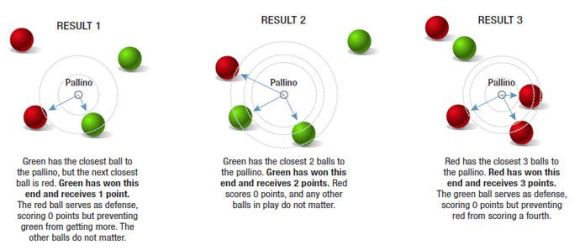
g.Scoring At the end of each frame (when both teams have exhausted all balls), points will be determined as follows: Scoring points are all those balls of one team closer to the pallina than the closest ball of the opposing scoring team, which can be determined by viewing or by mechanical measurements. The scoring team for each frame will also win the pallina advantage for the subsequent frame. Referee will be responsible for validity of scoreboard and scorecard. It is incumbent upon the team captain to verify the accuracy of the posted score at all times.
h.Ties During Frame In the event that two opposing balls are equidistant from the pallina (tied), the team that rolled last will continue to roll until the tie is broken. Example: Team A rolls a ball for the pallina, and Team B rolls its ball for the pallina. The referee determines that they are both exactly 33cm (13") away from the pallina. Team B must roll until it has a point closer than 33cm (13" ) from the pallina. If Team B does roll up to the point and Team A hits that ball out re-establishing a tie, Team A must continue to roll until the tie is broken.
i.Ties at the End of Frame In the event that the two balls closest to the pallina belong to opposing teams and are tied, no points will be awarded. The pallina returns to the team which delivered it.
j.Winning Score – the league or tournament director may establish the winning score for each match. A score of 12 is traditional in tournament play. Tournament directors may wish to consider scoring to 15 for final round play.
k.Scorecard It is the responsibility of each team captain to sign the scorecard after a match. The signatures will indicate the indisputability of the final score. Games in which protests will be filed should not be signed by any captain disagreeing with the score or its validity.
2.Player Designation
a.Captain On any team, the captain must be designated and made known to the officials before play begins. The captain may not be changed during the course of the game, but may be changed during the course of a tournament or league. The tournament or league officials must be notified of this change prior to any subsequent games.
b.Rotation of Players The players of any given team may elect to play their ball in any rotation provided the player who tosses the pallina delivers the first bocce ball. The rotation may vary from frame to frame; however, no player may deliver more than his/her allotted number of balls per frame. (Refer to Rule 2, Section III, Article 8.)
3.Unified Sports® Team
a.Each Unified Sports® doubles team shall consist of one Athlete and one Partner.
b.Each Unified Sports® team event shall consist of two Athletes and two Partners.
c.Each game shall commence with a coin toss. Either members of the team that wins the toss starts the game by throwing the pallina and the first ball. The second ball is thrown by either member of the opposing team. Play continues with an alternation of throws by Partners and Athletes until the game is won.
4.Substitutions
a.Official Notification Officials must be notified of substitutions prior to scheduled game time of it will result in forfeiture of match.
b.Substitution of Players
1)Substitution of Players Only one substitute may be allowed per team per game. substitute may take the place of any player on the team and may substitute for different players on the same team during different games.
2)Limitations Once a player has registered to substitute for one team during the tournament, he may not substitute for any other team during that tournament.
c.Substitution During Game
1)Emergencies Only in the event of medical or other verified emergencies may a player be substituted during the process of a game. Emergency substitutions will only be made at the end of a frame; if this is not possible, the frame will be considered dead. However, once the substitution has been made, the substitute must complete the game.
5.Time-Outs, Delays-of-Game, and Checking Position of Points
a. Circumstances
1)Time Out The official may grant a time-out whenever the circumstances explained appear to be of sufficient validity to do so. The time-out will be limited to ten minutes.
2)Intentional Delay of Game If, in the opinion of the official, the game is intentionally delayed without sufficient or valid reason, the official must give a warning. If play is not resumed immediately, the delaying team will forfeit the match.
3)Delays Caused by Weather, Acts of God, Civil Disorder or Other Unforeseen Reasons- In such delays, the ruling of the League or Tournament Director will be decisive and final.
4)Checking Position of Points Players may only proceed to the half court mark before delivering their ball(s). Exceptions: For one player teams, player may proceed down court at any time to observe conditions. For two-player teams, one player may proceed down court to observe conditions before delivery. When only one team has exhausted all of its balls, the referee shall not be permitted to declare, by measurement or viewing, which team is "in".
6.Penalties
a.Enforcement of Penalties
1)Determination immediately upon determination by the official that a foul has been committed, the official will notify the captains of both teams and inform them of the penalty imposed. The ruling of the official is final, except as otherwise provided for hereafter.
2)Conditions Not Covered For conditions not specifically covered in the official International Bocce Association Rules, the League or Tournament Director's ruling shall be decisive and final.
3)Protests Any protest to an official's or Tournament Director's decision must be made by a team before that team plays its next ball, or the decision will be considered as accepted.
4)Protest to Forfeiture If a team must forfeit a match as a result of not being present for a scheduled match, or as a result of violations hereunder prescribed, no official protest will be acknowledged. Protests will be acknowledged and judged on the basis of merit in circumstances not specifically proved for hereunder.
b.Specific Fouls
1)Foul-line Fouls In both pointing and hitting, the foremost part of the specific foul- line will not be surpassed by any part of the foot before the ball leaves the player's hand. All fouls must be called by a referee as a result of witnessing the foul. One official warning may be granted each team after which penalties will be prescribed. The penalty for a team committing a second foul-line infraction will consist of one of the following two options:
a)The team fouled against will be awarded points as they were immediately preceding the foul, and the frame will end. The referee will make the final judgment as to how many points were actually "in" at the time. The team committing the foul will be awarded no points for the frame.
b)The fouled against team may have the option of declining the penalty and completing the frame.
2)Illegal Movement of a Ball Belonging to Your Own Team If a player moves one or more of his/her team's balls "in contention", the ball(s) are removed from the court and considered dead and play continues. Balls not immediately "in contention" may be replaced as close as possible to their original position. "In contention" is herein defined as a ball(s) close enough to the pallina to require measurement to determine whether a point may be awarded.
3)Illegal Movement of an Opponent's Ball If a player moves one or more of his/her opponent's balls "in contention", those balls will be awarded one point each and play continues. Only the team fouled against can be awarded points for that frame unless the penalty is declined.
4)Illegal Movement of the Pallina by a Player If the pallina is moved by a player, the team fouled against may be awarded as many points as the number of live balls that were "in contention" plus the number of balls yet unplayed by that team during the frame in which the fouled occurred.
5)Declination of Penalties The team fouled against shall retain the privilege of declining any of the prescribed penalties and completing the frame.
c.Accidental or Premature Movement of Balls or Pallina by Referee
1)Accidental Movement of a Ball or Pallina During Play (when more balls are yet to be played) If a referee, either in the course of measuring or otherwise moves a ball "in contention" or the pallina, the frame is considered dead and started over at the same end.
2)Accidental or Premature Movement of a Ball or Pallina by a Referee After All Balls Are Played If the point or points were obvious to the referee, they will be awarded. All uncertain points will not be awarded.
d.Interference with a Ball in Motion
1)By One's Own Team If a player interferes with his/her team's ball in motion, his/her team automatically forfeits the ball and play continues. If balls in play are disrupted as a result, refer to RULE FIVE, Section two, Articles two, three, and four.
2)By Opponent's Team If a player interferes with an opponent's ball in motion, the team fouled against has one of the following options:
a)playing the ball over.
b)declaring the frame dead.
c)declining the penalty, accept the lie of the touched ball, and continue playing.
3)With No Disruption of Position If a spectator, animal or object interferes with a ball in motion and that ball does not touch another ball already in play, it must be played over by the same player.
4)With Disruption of Position If a spectator, animal or object interferes with a ball in motion and that ball touches another ball already in play and "in contention", the frame is dead.
5)Other Disruption of Play Any action which interferes with the position of the pallina or the ball of each team closest to the pallina renders the frame dead. In the event balls other than the pallina or the two opposing balls closest to it are moved, they may be replaced as close as possible to their original position by the two captains or referee. Such disruptive action may be the result of a dead ball from another court, foreign objects, spectators, or animals entering the court and changing the position of the ball(s) in play.
e.Wrong Color Delivery
1)Replaceable If a player delivers a wrong color ball, the ball may not be stopped by another player or the referee. The ball must be allowed to come to rest and replaced with the proper ball by the referee
2) Not Replaceable If a player delivers a wrong color ball which cannot be replaced without disturbing another ball already in play, the points of the play will be recorded at that time, wrong color ball counting for team which rolled or delivered it, and play will continue. It will be the responsibility of the two team captains and the referee to maintain identity of the "wrong color" ball(s).
f.Wrong Rotation of Play
1)Initial Roll If a team wrongly delivers the pallina and its first ball, the referee will return both pallina and ball and begin the frame over from same end.
2)Subsequent Rolls of Proper Color in Improper Sequence If a player delivers his/her ball when his/her team is "in" and the other team still has balls left:
a)the opposing team may leave everything, including the thrown ball exactly as is, or
b)may return any moved balls to their approximate previous positions and removed the thrown ball.
7.Officials
a.Objections
1)Objections to Officials Each team has the right to object to a designated official for any reason prior to the start of a game. This objection will be considered and decided upon by the Tournament Director.
2)Participant Officials No member of a team or registered substitute of a team will be allowed to assist in officiating a game in which that team is also playing.
b.Substitute Officials
1)During a Game Substitutions of officials may occur during a game only with the permission of the Tournament Director and both team captains.
2)Additional Officials Additional officials may be assigned to any games during the course of play provided permission is granted by the Tournament Director.
3)Team Requests Officials may be changed during the course of a game if either team presents sufficient cause to the Tournament Director.
4) Official's Uniform Referee should be clearly distinguishable from players. It is recommended that vests or hats should be worn.
c.Ethics
1)Officials' Code of Ethics A referee will:
a) study the rules of the game.
b)be fair and unbiased in his decisions, rendering them without regard to the score.
c)be firm but not overbearing; courteous but not ingratiating; positive, but never rude; dignified but not arrogant; friendly but companionable; calm, but always alert.
d)be prepared, both physically and mentally, to administer the game.
e)not give information which would benefit or give advantage to one team over another.
8.Other Circumstances
a.Broken Ball
1)During Play If during the course of a frame a ball or pallina should break, the frame will be considered dead. Replacement of ball or pallina will be the responsibility of Tournament Directors.
b.Court Grooming 1) Prior to Play All courts must be groomed to the satisfaction of the Tournament Director before the start of each game. 2) Court Grooming During Play Courts may not be regroomed during the course of the game. Obstacles or objects such as stones, cups, etc. may be removed during the course of a game. 3) Unusual Court Conditions If in the opinion of the Tournament Director, the court conditions are such that play is impractical, the game can be stopped and resumed on another court or at another designated time.
c.Moving Objects
1)Moving Ball or Pallina No player may play his ball until a pallina or another ball has come to a complete rest. Penalties refer to RULE FIVE, Section four, Articles one and two.
9.Player Behavior
a.Unsportsmanlike Conduct
1)Disqualification Players shall act in a sportsmanlike manner at all times. Any act which is deemed as poor sportsmanship such as insulting language, gestures, actions, or words which engender ill-will, if flagrant, may result in disqualification.
b.Attire
1)Proper Attire Players will dress in a manner which will bring credit to them and the sport of bocce.
2)Footwear Players will not be permitted to wear shoes which may damage or disrupt the court surface. Also, players will not be permitted to play without shoes.
3) Objectionable Attire Players wearing objectionable or offensive clothing, or who are improperly attired, may not be allowed to participate in a tournament. The Tournament Director shall be the final authority.
SECTION D DEFINITION OF PLAYING TERMS
1. Ball: Live and Dead
2.Bocce Ball and Pallina
a.Pallina is a small object ball sometimes called cue ball, jack, beebee, etc.
b.Bocce Ball is the larger playing ball.
3.Other Terms
a.Hitting is sometimes known as spocking, shooting, bombing, etc. A delivery which is thrown with sufficient velocity that it would hit the back board if it missed the target. The shooting line will be used to determine a foul.
b.Bank or Rebound Shot refers to playing a ball off either the side boards or backboard.
c.Pointing is a ball delivered to obtain a point close to the pallina. The pointing line will be used to determine a foul.
d.Frame is the period in the game in which balls are played from one side of the court to the other and points are awarded.
4.Foul
a. A foul is a rule infraction for which a penalty is prescribed.
|